Colour changes between orders
A shared physical shade reference and recorded dye-lot checks help keep different locations on one palette.
Factory-direct uniform solutions
Medical uniforms, safety workwear, hospitality, corporate wear and private-label collections — developed around your roles, locations and brand. Keep colour, fit, branding and order records together so the next site starts from an approved specification.
Why programmes break
A multi-site rollout needs more than a matching logo. Resolve the points that create replacement costs, fit complaints and delayed openings.
A shared physical shade reference and recorded dye-lot checks help keep different locations on one palette.
Approve a graded measurement chart and size set, then inspect production against the same tolerances.
Define the required material, product and inspection records in the PO before production begins.
Schedule sampling, bulk production and freight as separate milestones against your first-site deadline.
Retain an approved pre-production garment and revision-controlled specification for line checks and reorders.
Coordinate fabric, patterns, decoration and packing through one programme specification.
Connect the agreed lab reports, material references and inspection results to the order they cover.
Use the signed sample, measurement chart and artwork as the reference for every production run.
Five industry programmes
Explore the programme that matches your roles and buying priorities. Each connects garment development, sample approval and location-by-location delivery.

Multi-site medical uniforms
Scrubs, lab coats and clinical wear coordinated by role and department.
Agree the fabric, care method and physical colour reference; use a ΔE ≤1.5 colour target with the measurement conditions recorded.
A shared size chart and site-labelled packing list make staff issue and replenishment easier.
Explore the medical programme
Construction, oil & gas safety workwear
Hi-vis, FR workwear and industrial garments for site crews.
Map each role and destination to the relevant requirements — ANSI/ISEA 107, EN ISO 20471 or NFPA 2112 — then define the garment evidence and care instructions in the brief.
Keep applicable reports and inspection records with the PO, and allocate garments by crew and size.
Explore the safety programme
Hospitality uniform programmes
Chef jackets, aprons, service wear and housekeeping uniforms developed as a range.
Choose coordinated fabrics and decoration suited to each role. Agree ISO 15797 or ISO 6330 wash trials and a 50+ cycle target where the selected textile supports it.
Pack by property and department so each venue receives the right sizes without central re-sorting.
Explore the hospitality programme
Corporate identity uniforms
Corporate shirts, polos and tailoring matched to your company identity.
Approve the physical palette, logo position and embroidery or print sample. Develop XS–6XL grading for the selected styles and retain the accepted measurements.
Give branches one purchasing reference for colour, fit, branding and repeat-order packing.
Explore the corporate programme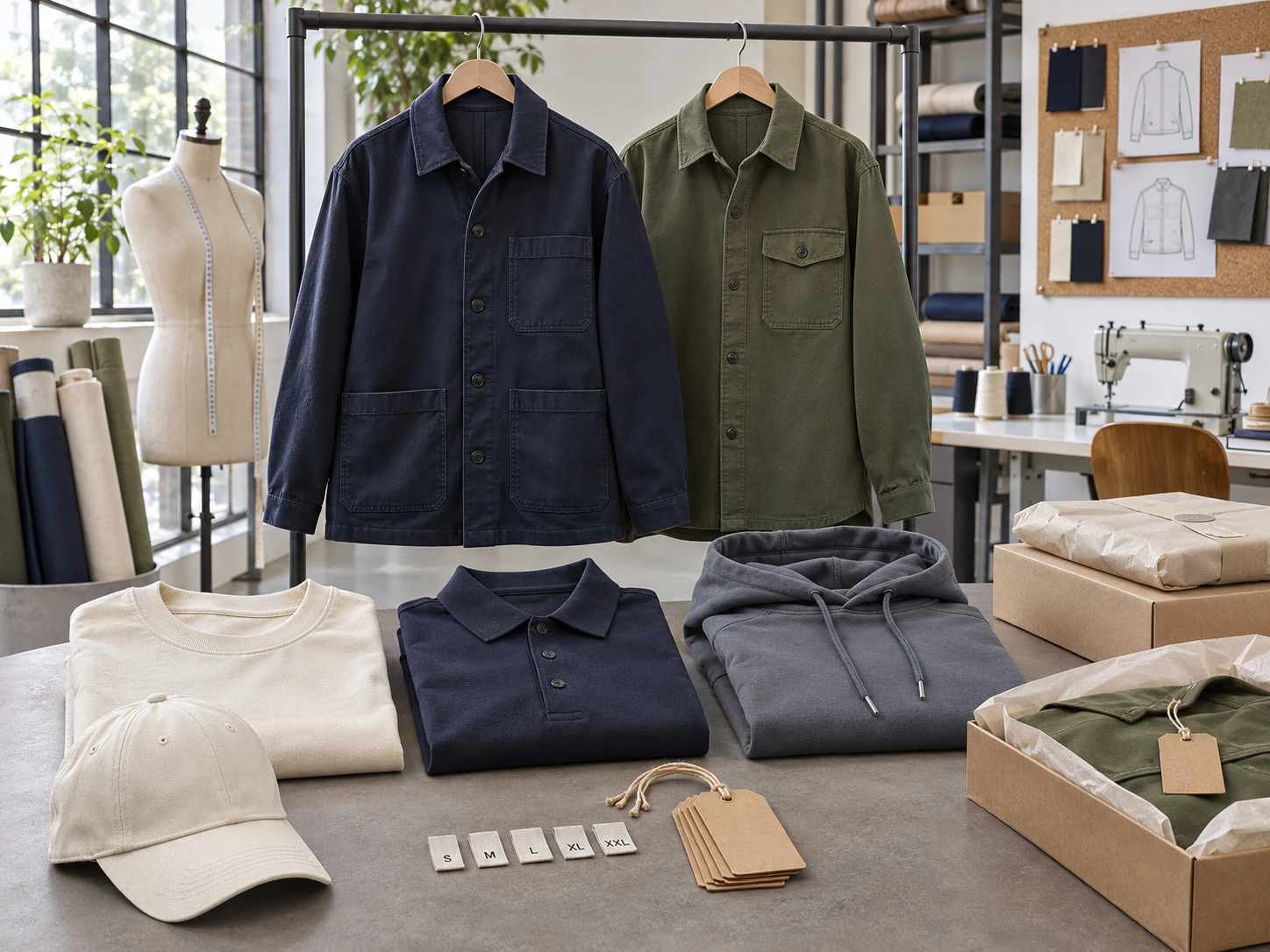
Private label & DTC custom workwear
Custom workwear, branded basics, labels and retail-ready packaging for your own line.
Start at 50 pieces per SKU. Set file access and confidentiality terms before sharing development files; approve construction, fit, labels and packaging on the sample.
Keep the accepted pattern, bill of materials and branding revision together for repeat production.
Explore the private-label programmeNot sure which programme fits? Send your roles, site count and destination to our team.
How a programme runs
Turn a brief into an approved garment, an inspected order and a delivery your receiving team can issue.
24-hour quotation response
Include garment references, quantities, standards, destination and site list. We review the brief and identify the decisions needed for a comparable quotation.
5 business days
Plan sampling once the brief and available materials are ready. Check fit, colour, construction and branding; retain the approved sample before releasing bulk.
15–20 days from approval
Schedule bulk after final sample approval and material readiness. Use the agreed measurement, shade and AQL inspection plan to assess production.
Filed by purchase order
Link agreed material and test records to the PO. Label cartons by location, department and size, with a packing manifest for receiving teams.
Repeat styles can be planned at 10–14 production days when the specification is unchanged and materials are available. Confirm sampling credits and the transport route in your quotation; freight is separate from production.
Sampling & approval
Put measurable acceptance criteria into the brief before the sample is cut. These are approval requirements for the selected programme.
| Criterion | Approval rule |
|---|---|
| Dimensions & fit | Confirm the tech-pack tolerance before cutting; ±0.5 in / 1.3 cm is the reference band unless the style requires tighter control. |
| Colour | Agree a ΔE ≤1.5 target against the accepted physical reference, with formula, illuminant and observer recorded. Assess the finished garment. |
| After-wash performance | Agree the care method, temperature, cycle count and acceptance limits. ISO 6330 at 60 °C may be used when appropriate; industrial laundering follows the agreed ISO 15797 procedure. |
| Hi-vis layout | Check background and retroreflective areas, tape placement and garment design against the applicable ANSI/ISEA 107 or EN ISO 20471 class. |
| Batch inspection | Use the agreed ISO 2859-1 General Inspection Level II sampling plan: Critical 0 / Major AQL 2.5 / Minor AQL 4.0. |
| Order documentation | Identify the required material records, laboratory reports and 4-point fabric inspection record in the PO and connect them to the supplied lot. |
Commercial or industrial wash, temperature, detergent, drying and finishing method.
Headcount, garment type, role colour and protective requirements for each site.
Quantities by size and role; supply body measurements for made-to-measure work.
A physical swatch, existing garment or agreed Pantone reference to approve.
The receiving market and required product standards, rather than an unqualified list of certificates.
The first site opening or staff issue date, destination and delivery term.
Procurement & QC checklist
Request a checklist organised around your market, garments and required evidence.
Your next purchasing meeting
Tell us your destination and uniform types. Ask for the procurement checklist with your enquiry, and we can address the relevant sections alongside the quotation.
Request the ChecklistGo deeper
Read more about development, manufacturing and the requirements behind a coordinated uniform range.
Sourcing
Compare development, MOQ, branding and order ownership.
Explore private-label manufacturing →Quality control
Translate fabric, fit and branding decisions into inspectable requirements.
Explore our factory and capabilities →Medical fabrics
Match clinical roles, colour and care in the medical programme.
Explore multi-site medical uniform programmes →Manufacturing
Connect cutting, sewing, decoration and packing to one accepted design.
Explore cut-and-sew manufacturing →Uniform solutions FAQ
MOQ, lead times, sample approval and multi-site replenishment — the practical questions behind a programme.
Production starts at 50 pieces per SKU. Send the style, colour and size breakdown so we can confirm how the minimum applies. A pre-production sample can start from one piece. Confirm the sampling fee, any first-order credit and the minimum for each repeat order in the quotation.
Plan 5 business days for sampling after the complete brief and available materials are ready, then 15–20 production days after final approval. Freight is a separate planning window of approximately 14–20 days for the agreed route. A first-order plan may total 5–7 weeks; destination, revisions and material sourcing can change it. Unchanged repeats can be planned at 10–14 production days subject to material availability.
Fit and dimensions must meet the agreed tolerance, colour must meet the accepted reference and measurement method, and construction, branding and wash performance must meet the brief. Use the approval table above to record the limits. Protective garments also need the evidence applicable to the exact style and destination.
Yes. Build a role-by-site matrix, approve one specification revision and record quantities by size and location. Use the same colour, measurement and logo references for each site. We can prepare location-labelled cartons and a site-level packing manifest; new materials or design changes go through approval before a repeat run.
Send a reference garment, colour swatch, artwork and size chart. We can develop the pattern, source a suitable fabric and prepare embroidery or print samples. Approve the physical shade, finished measurements and decoration on the pre-production sample. If the original material is unavailable, review a clearly identified alternative before bulk production.
Start your programme
Send garment references, sizes, quantities, destination and first delivery date. We will help define the material, branding, approval and packing requirements.